⚛️ Black Box
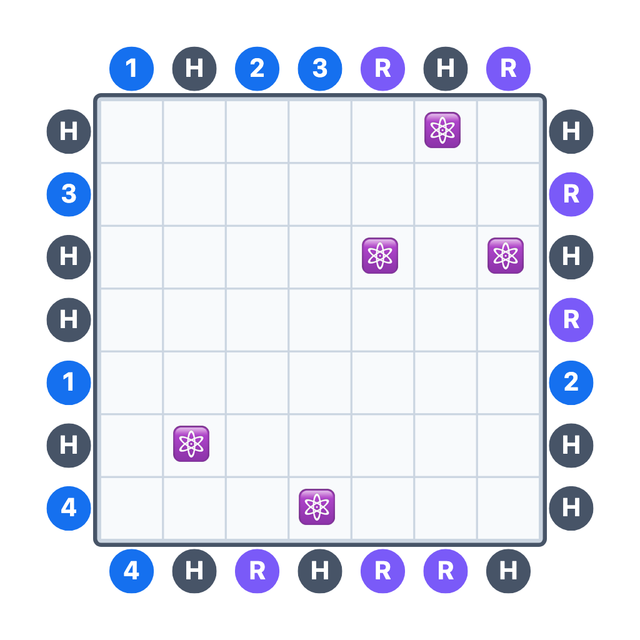
Trace the rays to find the hidden atoms in the box.
About Black Box
Black Box is the only puzzle here where you never see the board you are solving. Atoms are hidden in a grid, you are told how many, and rays have already been fired into the box from every port around the edge. The results of those rays — absorbed, reflected, or emerging from some other port — are your entire evidence, and you deduce the atoms from them.
It is an inference puzzle rather than a construction puzzle, closer to a scientific experiment than to filling a grid. Nothing you mark is checked against a rule in the way a tent or a tree is; instead you propose a placement and ask whether it would have produced exactly the readings on the ring. That difference makes it the most distinctive game in the collection, and the one most worth reading the rules for before starting.
The four outcomes and what each proves
A hit means the ray ran straight into an atom, which tells you an atom lies somewhere along that entry line — a strong, simple constraint and the best place to start. A detour means the ray came out elsewhere, and because detours are two-way, the matching number at another port gives you both ends of one path.
A reflection is the subtlest and often the most informative. It happens when atoms sit diagonally ahead on both sides of the ray, when an atom sits diagonally beside the entry port so the ray never enters at all, or when a chain of deflections happens to send the ray back out where it came in. That first case pins two atoms in relation to each other; the second is almost a direct reading of a single atom's position.
Deflections happen without advancing
The rule that trips people up: a ray turns when an atom sits diagonally ahead of it, and it does not move forward while turning. So it can turn several times in succession, and a ray can leave from any port on any side — not just the far one.
This is why tracing matters more than intuition here. When you are testing a candidate placement, walk the ray one step at a time and check both diagonals before each advance. A single missed diagonal will produce a path that looks plausible and exits at the wrong port, and you will trust it.
Work from the empty lines
The most useful early information is often negative. A ray that passed straight through the box and came out directly opposite tells you there was no atom on its line, and none diagonally adjacent to that line anywhere along it either — otherwise it would have deflected. That clears a wide band of the grid in one move.
Collect all of those first and mark the cells they exclude. The hits and detours are harder to place precisely, but once most of the board is excluded, each remaining hit line usually crosses only one or two possible cells.
Choosing a size
Small boards have short ray paths and few atoms, so a single reading often localises an atom immediately and there is little room for long deflection chains. They are the right place to learn the geometry of a turn.
Larger boards allow more atoms and much longer paths, and the difficulty grows faster than the area does: rays interact with several atoms in sequence, so a detour's two ports may be connected by a path with three or four turns in it. On the bigger boards you will lean much more on the negative information from clean pass-throughs.
What the difficulty labels mean here
Every published board has exactly one placement of atoms that reproduces the full ray table, so the answer is never a coin flip between equally good explanations. The measured score reflects how much of the deduction was forced by individual readings and how much required testing a candidate placement against the whole ring.
An Easy board can be read almost port by port. A Hard or Insane one has readings that are individually ambiguous — several atom positions would produce the same reflection — and only the combination of all of them is consistent. That is genuinely the hardest kind of reasoning on this site, which is worth knowing before you pick an Insane board.
Similar games
Games that share tags with Black Box.