🚢 Battleships
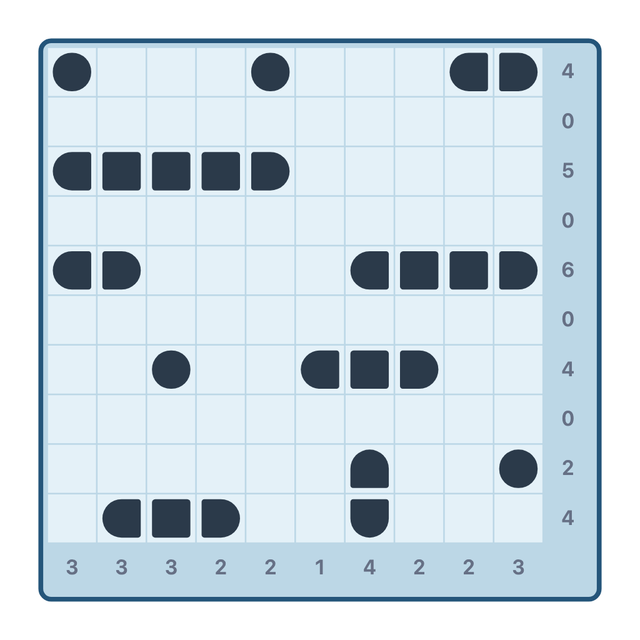
Find the hidden fleet using the row and column clues.
About Battleships
Battleships turns the pen-and-paper guessing game into something with a single provable answer. A fleet of ships is hidden in the grid, the numbers along the edges tell you how many ship cells sit in each row and column, and no two ships may touch — not even at a corner. From that alone, exactly one arrangement is possible.
It plays quite differently from the grid-filling puzzles alongside it. Here you are working with two separate kinds of information at once: the edge counts, which are arithmetic, and the fleet list, which is about shape. Most of the satisfaction comes from the moments those two lines of reasoning meet — when a count tells you a row holds three ship cells and the fleet list tells you the only unplaced ship that could produce them.
Reading the two kinds of clue
The edge numbers are the loud clue and the easiest to over-rely on. They are strongest at their extremes: a zero empties an entire line in one move, and a count equal to the line's length fills it. In between they constrain rather than determine, and their real use is subtractive — once a line has its full count of ship cells, every remaining cell in it is water, and water is what shapes the ships next door.
The fleet list is the quieter clue and usually the one that finishes the puzzle. It tells you not just what is left to place but what is left to place *somewhere it fits*. Late in a solve the largest unplaced ship is often the whole answer: there may be only one run of open cells long enough to hold it.
Why the no-touching rule does the heavy lifting
It is tempting to treat "ships cannot touch" as a validity check you apply at the end. It is actually the most productive deduction rule on the board. Every ship cell you establish immediately makes all eight of its neighbours water except along the ship's own axis, and every ship you complete surrounds itself in a full ring of water.
That ring is the point. A finished ship does not just fill its own cells — it hands you a boundary of known water that cuts the surrounding region into separate runs of open cells, and those runs are what you measure the remaining fleet against.
Choosing a size
Smaller boards carry smaller fleets, so the fleet list stays in view and the counting is short. They suit learning the interaction between the edge counts and the no-touching ring, because the whole board is close enough that one deduction visibly changes the rest.
Larger boards hold larger fleets, and with them a different problem: several ships of the same size, which means the question stops being "where does this ship go" and becomes "how many of these fit here". Expect to spend more time on water than on ships. Marking water is not bookkeeping in this game — it is the deduction.
What the difficulty labels mean here
Difficulty is measured by the solver rather than chosen when the puzzle is made. Each board is solved by the same kind of reasoning a person uses, and the score counts how far the solver had to search once the forced moves ran out. An Easy board has a certain next move at every point. A Hard or Insane one contains at least one position where you must consider a possibility, follow its consequences, and rule it out.
A useful practical reading: if you are stuck on a puzzle labelled Easy, you have missed something visible, and recounting the lines will find it. If you are stuck on an Insane one, you may genuinely need to test a placement and see what breaks.
How a solve usually opens
Start with the extremes, always. Sweep for zero rows and columns and flood them with water, then sweep for any line whose count matches the number of cells it has left. This costs nothing and usually opens two or three regions at once.
Then place the largest ship if you can. Long ships have few homes, and the edge counts tell you which lines are capable of holding one — a row with a count of four cannot contain a ship of five, and a row whose open cells come in runs of three cannot either. Once the biggest ship is down, its surrounding water tends to decide the next two.
Similar games
Games that share tags with Battleships.