🪴 Landscaper
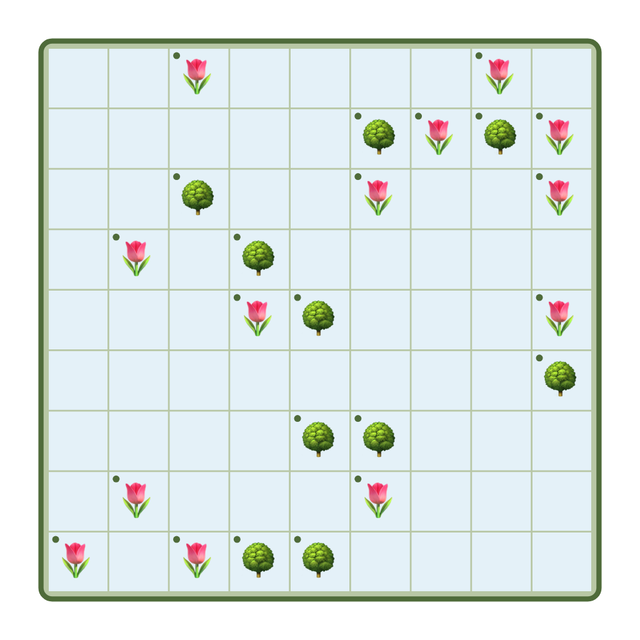
Plant trees and flowers to balance every row and column.
About Landscaper
Landscaper is a binary puzzle in disguise. Every cell holds either a tree or a flower, each row and column must hold a fixed number of each — half and half on an even board, one extra tree on an odd one — no three identical plants may sit consecutively in a line, and no two completed rows may be identical, nor two completed columns.
What sets it apart from the clue-counting games is that there are no clues. Nothing is written around the edge and nothing is given except a handful of starting plants. Every deduction comes from the four rules interacting, which makes it the purest constraint puzzle in the collection and the one that rewards pattern recognition most directly.
Two patterns do most of the work
The no-three-in-a-row rule shows up in two shapes, and once you can see them the game speeds up enormously. A pair of identical plants must be capped at both ends: two trees side by side force flowers immediately before and after them. And a gap between two identical plants must be filled by the opposite: a tree, an empty cell, a tree means the middle is a flower, since a tree there would make three.
These are local, mechanical, and everywhere. Sweep the whole board for them after every few placements rather than reasoning cell by cell — most of a Landscaper solve is applying these two patterns repeatedly until the quotas take over.
Then the quotas finish the lines
Each line holds a known number of each plant, so as soon as one plant reaches its quota in a line, every remaining cell in that line is the other plant. This is the counting half of the game and it is what converts the local pattern work into completed lines.
The two halves feed each other. Capping a pair adds plants to several columns at once, which may push one of them to its quota, which fills a column, which creates new pairs and gaps in the rows it crosses. A board that seems stuck usually just needs a careful recount of every line.
The uniqueness rule is a real tool
No two completed rows may match, and the same for columns. Because it only applies to lines that are entirely filled, it is easy to file away as a validity check — but it is genuinely deductive, and on harder boards it is indispensable.
The move to look for: a finished row, and another row that matches it everywhere except a single undecided cell. That cell must take whichever value makes the two rows differ, because matching is forbidden. A slightly stronger version works before either row is complete — two incomplete rows that already agree everywhere they are filled must differ somewhere, so if only one of them still has freedom, that is where the difference has to land.
Choosing a size
On the smaller boards the quotas are small and the no-three rule bites almost immediately, so the two local patterns will carry you most of the way. The uniqueness rule seldom needs to be used, because there are few lines to collide.
Bigger boards change that balance. Longer lines mean the quotas take much longer to saturate, so the local patterns get you a partial board and then stall — and with many more lines, near-duplicate rows and columns become common, which makes the uniqueness rule a routine part of the solve rather than a curiosity. Odd-sized boards are worth a moment's care too, since the quota is not an even split.
What the difficulty labels mean here
The measured score reflects how far the board went on forced pattern-and-quota moves before search was needed. An Easy Landscaper board is a long chain of caps, gaps and completed quotas with no decision points at all.
The harder ones have positions where no pattern applies and no line is near its quota — and those are almost always resolved by a uniqueness argument, or by assuming a plant and finding that some line ends up needing three in a row. If you are stuck, compare your rows against each other before re-examining any single cell.
Similar games
Games that share tags with Landscaper.