🏙️ Skyscrapers
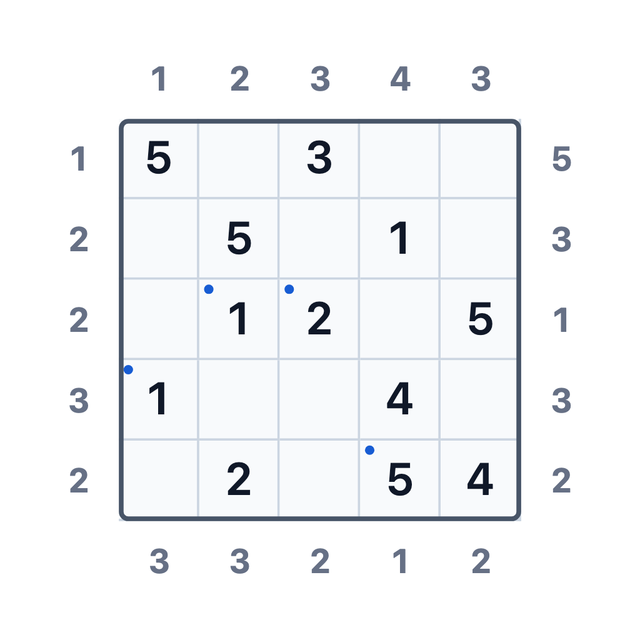
Place heights so every border clue sees the right number.
About Skyscrapers
Skyscrapers is a Latin-square puzzle with a visibility twist. Every height from 1 to the grid's size appears exactly once in each row and column, and the numbers around the outside tell you how many buildings you would see looking along that line from that side. A building is visible only if it is taller than everything in front of it, so a tall building hides every shorter one behind it.
The clues are therefore not about position but about order, which is what gives the game its character. A clue of 1 or a clue equal to the grid size tells you an entire line at once. The numbers in between are about how the heights are sequenced, and learning to read them is the whole skill.
The two extreme clues are gifts
A clue of 1 means the very first building blocks everything behind it, which is only possible if it is the tallest in the line. Write the maximum height in that cell immediately.
A clue equal to the size of the grid means every building is visible, which forces a strictly increasing sequence — 1, 2, 3, and so on away from that edge. There is exactly one arrangement, so the entire line is solved from a single number. On the smaller boards these two clues alone often crack the puzzle open.
Reading the middle clues
The intermediate numbers work as bounds rather than answers. The useful fact is that a clue of C requires at least C − 1 cells behind the first one to hold the remaining visible buildings, which keeps the tallest building away from the near edge. Concretely, a tall building close to the edge cuts the visible count down hard, so a large clue pushes the big heights back and a small clue pulls them forward.
The sharpest version of this is the standard corner argument: with a clue of 2, the near cell cannot hold the maximum height (that would make the count 1), and it usually cannot hold the second-tallest either, depending on the size. Each of those exclusions is small, but they compound quickly with the Latin-square constraint.
Choosing a size
These boards stay comparatively small, and for a good reason: the number of orderings in a line grows extremely fast, so a large grid would stop being solvable by reasoning and start being a search. The smallest boards are genuinely introductory — few heights, so the extreme clues nearly finish them.
Stepping up a size adds heights, and each new height multiplies the possible sequences in every line. The practical difference is that you stop solving lines one at a time and start using the row and column constraints together, eliminating a height in one line because it is already committed in a crossing one.
What the difficulty labels mean here
The solver score records how much search was needed after the forced deductions ran out. An Easy board has enough extreme and near-extreme clues that each line resolves in turn.
The harder boards are the ones with mostly middling clues, where no single line is determined and progress comes from candidate elimination across the whole grid — the same feeling as a hard Latin-square puzzle, with visibility standing in for the usual constraints. Expect to pencil candidate heights into cells rather than committing.
How a solve usually opens
Scan the border for 1s and for clues equal to the grid size, and fill in everything they give you. Then look at clues on both ends of the same line: two clues constrain one sequence far more than either does alone, and a pair like 2 and 2 on a small board is often fully determined.
From there it is ordinary Latin-square bookkeeping with a visibility filter. Place a height, strike it from the rest of its row and column, and re-test the clues on any line you touched — a clue that was merely a bound often becomes exact once one height is fixed.
Similar games
Games that share tags with Skyscrapers.