🌿 Edaburi
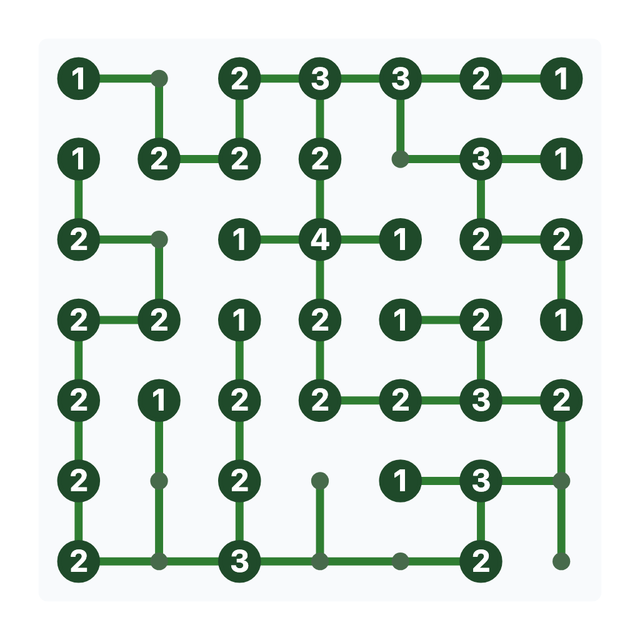
Grow one branching tree through every numbered circle.
About Edaburi
Edaburi asks you to grow a single tree, in the graph sense. Circles sit on the board, you draw branches between horizontally or vertically adjacent circles, a numbered circle must have exactly that many branches touching it, and when you are finished every circle must be connected into one structure containing no loop.
The two global conditions are the heart of it. Connected and acyclic together mean the finished figure is a spanning tree, and that is a much stronger requirement than either alone. It gives the game a distinctive rhythm: the numbers get you a long way locally, and then the tree conditions decide everything that is left.
The degree clues come first
Every numbered circle tells you its exact degree, so begin by counting how many neighbours each one even has. A circle whose number equals its neighbour count is fully determined — draw every branch. A circle clued 1 has exactly one branch and you may not know which yet, but every other option will be eliminated soon enough.
Circles in corners and along edges are where this pays off, because they have fewer neighbours to begin with and are far more likely to be saturated. Work the boundary before the middle, exactly as you would in the other connect-the-dots puzzles here.
No loops, which means counting branches
A tree on N nodes has exactly N − 1 edges. That is not a piece of trivia — it is a running total you can check against. Count the circles, subtract one, and you know precisely how many branches the finished figure contains, which means you also know how many you have left to draw at any moment.
It also gives you the local version, which is the one you will use constantly: if two circles are already connected to each other through some path of branches, you may never join them directly, because that would close a loop. Whenever a branch would complete a circuit, mark it as impossible.
Connectivity forbids premature closure
The mirror of the loop rule is that nothing may finish early. If a group of circles has satisfied all of its own numbers using only branches inside the group, and that group is not every circle on the board, the arrangement is wrong — the rest of the board could never reach it.
This is the argument that resolves the ambiguous endgames. When you have two candidate branches and the numbers cannot distinguish them, check which one would seal a subgroup off. That one is out.
Choosing a size
The smaller boards have few enough circles that the degree clues nearly finish them on their own, and the tree conditions serve mostly as a final check. They are the right place to get comfortable with the idea that a branch is forbidden as soon as it would close a loop.
On the larger boards the circles form long chains and open middles where several branch patterns satisfy every number locally. That is where the N − 1 count and the no-premature-closure argument become the primary tools rather than the safety net. Expect the last stretch of a big board to be about the shape of the whole tree rather than about any one circle.
What the difficulty labels mean here
The score counts how much search the solver needed after the forced branches were exhausted. An Easy board is a chain of saturated circles, each one settling the next.
The harder boards leave you with regions where the degrees are all satisfiable in more than one way, and only the global tree structure picks the right one. If you are stuck, count your branches against the circle count minus one, and look for a subgroup that has quietly finished itself.
Similar games
Games that share tags with Edaburi.