🔟 Tenner Grid
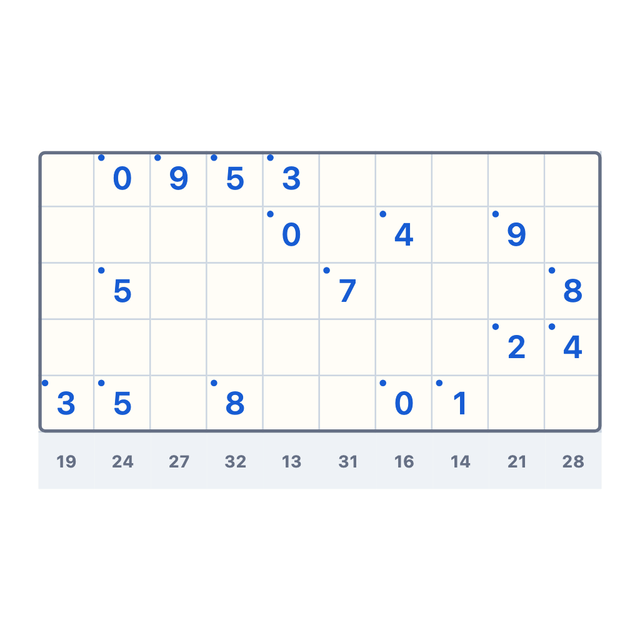
Place digits 0–9 so the column totals add up.
About Tenner Grid
Tenner Grid is the most arithmetic puzzle on this site. The board is always ten columns wide, every row holds the digits 0 through 9 exactly once, no two identical digits may touch in any of the eight directions, and beneath each column sits a target that its digits must add up to exactly.
The combination is what makes it work. The row rule is pure bookkeeping, the adjacency rule is spatial, and the column targets are genuine arithmetic — and because a digit may repeat down a column, the sums are not a formality you can derive from the rows. Most positions are cracked by playing one rule against another rather than by pushing any single one hard.
Work with the row's missing set
Every row contains each digit exactly once, so at any moment a row has a precise set of digits it still needs. That set, not the individual cell, is the right unit to think about — derive it first and the cell-by-cell candidates follow.
It also gives you a bound the column sums cannot ignore. The digits a row still owes have a fixed total, which means the cells of that row contribute a known amount spread across the columns. Late in a solve, comparing that total against the remaining column targets is often what breaks the position.
The column target is an equality
A target is not a maximum; the column must hit it precisely. So the productive move is subtraction: take the target, remove the digits already committed, and you have the exact sum the remaining cells owe.
Because digits may repeat down a column, that remainder is a real constraint rather than a derived one. A remainder of 3 across two cells admits very few pairs, and once you intersect those pairs with what each row still has available, the count usually drops to one. This is the single most reliable engine in the game.
Adjacency is eight-directional
The no-touching rule includes diagonals, which means a digit conflicts with copies in the rows above and below as well as beside it. That matters more than it sounds, because the row rule already forbids repeats along a row — so every adjacency deduction you actually make is vertical or diagonal.
Used well, it is the tie-breaker. Two candidates for a cell will often both satisfy the row and the column remainder, and only one avoids touching a copy of itself in the row above. Check the six cells in the neighbouring rows before committing anything.
Choosing a size
The width never changes — ten columns, ten digits per row — so what a size choice really changes is the number of rows, and with it the character of the column sums.
Few rows means small targets built from few digits, so a column remainder pins things down almost immediately and the adjacency rule has little room to matter. More rows means larger targets with many ways to reach them, so the sums become weaker individually while adjacency and the accumulating row sets become much stronger. The taller boards are longer, but they are also the ones where the three rules genuinely interlock.
What the difficulty labels mean here
The solver score records how far past forced arithmetic the board required a hypothesis. An Easy board always has a column whose remainder admits one option, or a row with a single digit left.
On a Hard or Insane board you will hit positions where every column remainder has several valid decompositions and no row is nearly complete. Those need candidate lists and a genuine test — and because ten digits per row is more than anyone holds comfortably in mind, this is the game where using the notes is not a crutch but the intended method.
Similar games
Games that share tags with Tenner Grid.