🐠 Aquarium
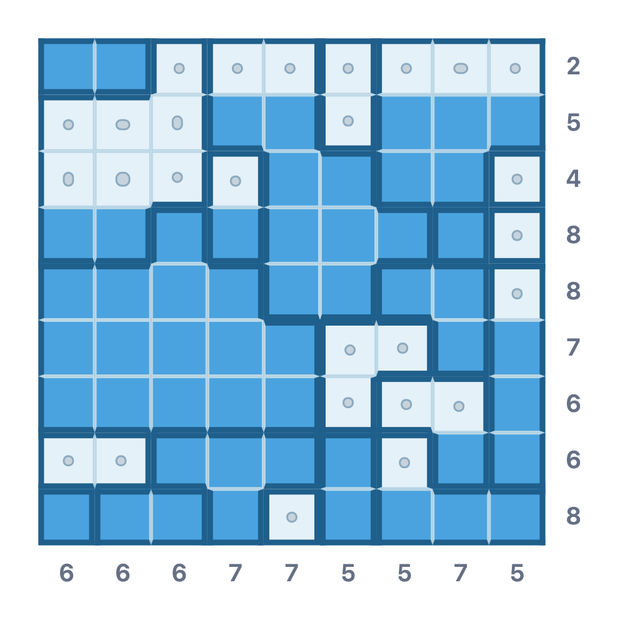
Flood each aquarium to match the row and column clues.
About Aquarium
Aquarium is built on one physical idea, and it is the reason the puzzle feels different from every other clue-counting grid. The board is divided by bold walls into aquariums, each cell is either air or water, and water behaves like water: inside any one aquarium it settles to a single flat level, filling everything at or below the surface and nothing above it.
The numbers beside the rows and columns count water cells, as you would expect. But the gravity rule is so strong that the clues are almost a secondary constraint. An aquarium of thirty cells does not have thirty independent decisions in it — it has one, namely how high the water rises.
Think in levels, not cells
The single most useful shift in this game is to stop treating cells as the unit of decision. An aquarium that spans six different rows has exactly seven possible states: empty, or filled to the top of each of those six rows. That is the whole search space for that aquarium, however many cells it contains.
Two consequences follow, and you will use both constantly. Within one aquarium, all cells in the same row share a state — so proving a single cell is water fills its entire row within that aquarium. And water sinks: one water cell means every cell of that aquarium below it is water, while one air cell means every cell of that aquarium above it is air.
Where the clues bite
Because an aquarium has so few states, the clues are best used to eliminate levels rather than to fill cells. Take a column clue, count how much water each candidate level of a crossing aquarium would put into that column, and discard the levels that overshoot.
This is where the game gets its bite. Aquariums are irregular, so one aquarium usually spans several columns and contributes a different amount to each. Raising its level by one row might add one cell to a narrow column and four to a wide one, which means a single tight column clue can cap a level far away from where you were looking.
Choosing a size
On the smaller boards the aquariums are few and shallow, so the number of levels each one can take is small enough to enumerate on sight. These are the boards to learn the flat-level and sinking rules on, because the whole shape of an aquarium stays visible at once.
The larger boards bring tall, irregular aquariums that snake across many columns, and with them the real puzzle: the level of one aquarium is decided by a clue that only touches a small part of it. You will do more counting and less shading. It helps to work one aquarium at a time and write down which levels remain rather than which cells are wet.
What the difficulty labels mean here
The solver score records how much of the level-fixing was forced by arithmetic and how much needed a hypothesis. An Easy board has a chain of aquariums whose levels each fall out directly from a clue, one after another.
A Hard or Insane board has interlocking aquariums — two that share the same tight columns, where several combinations of their levels satisfy every clue until you follow one of them further. Those are the positions worth slowing down for; the rest of the board typically resolves in a rush once they break.
How a solve usually opens
Begin with the extremes, which cost no thought: a clue of zero makes a whole line air, and a clue equal to the line length makes it all water. Both usually pin a level immediately, because they cut straight across several aquariums.
Then find the aquarium with the fewest possible levels — often a short, wide one — and test them against its columns. Every level you eliminate anywhere reduces a row count somewhere, and in this game one settled aquarium tends to settle its neighbours through the columns they share.
Similar games
Games that share tags with Aquarium.