🌉 Bridges
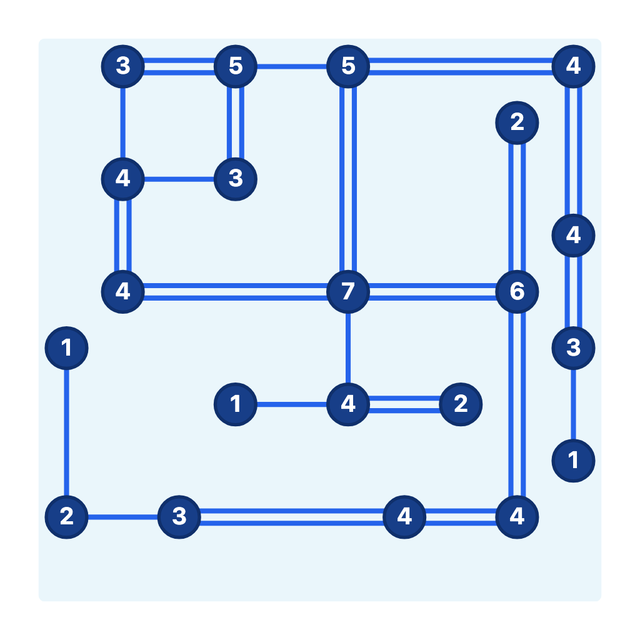
Link every island with bridges to make one network.
About Bridges
Bridges gives you numbered islands and asks you to connect them into a single network. Bridges run only horizontally or vertically, only between the nearest islands visible to each other in that direction, at most two between any pair — and the number on an island is exactly how many bridge lines must touch it. Bridges may not cross, and when you are done every island must be reachable from every other.
It is the one game here that is about a graph rather than a grid. The cells between islands barely matter; what matters is which islands can see each other and how much capacity each connection has. That change of object is why it feels quite unlike the shading and filling puzzles beside it.
Start from capacity, not from bridges
Before placing anything, count each island's neighbours — the islands it can legally reach — and note that each of those can carry at most two bridges. That gives a maximum for the island, and comparing its clue against that maximum is where nearly every opening move comes from.
The saturated cases are immediate. An island whose clue equals twice its neighbour count must run a double bridge to every one of them. The classic instance is an island clued 4 in a corner, with only two neighbours: both connections are doubles, and there is nothing to decide.
Near-saturated islands give partial certainties
The more interesting deduction is one short of saturation. An island whose clue is one less than its maximum cannot leave any neighbour unconnected — if it did, it would need to make up the shortfall somewhere already at its limit. So every neighbour gets at least one bridge, even though you do not yet know which connection is the single rather than the double.
That partial commitment is usually enough to move on with, because a single bridge laid down changes the count on the island at the other end, and its arithmetic may be tighter than the one you started from.
Crossing and connectivity are separate tools
The no-crossing rule works geometrically: a bridge you place blocks every perpendicular line through it, which can cut two distant islands off from each other entirely and remove them from one another's neighbour counts. Recompute those counts after each bridge rather than trusting the ones you took at the start.
The single-network rule is a different instrument and it is the one that finishes hard boards. If a group of islands has satisfied all its own numbers using only bridges within the group, it has sealed itself off — and unless it contains every island on the board, that arrangement is wrong. Spotting a premature closed cluster is often the deduction that unlocks the endgame.
Choosing a size
On the smaller boards the islands are few and mostly in each other's sight, so the capacity arithmetic does nearly all the work and connectivity rarely becomes an issue before the end.
The larger boards spread the islands out, and two things follow. Sightlines get long, so the no-crossing rule starts severing possibilities far from where you are working, and the network gets deep enough that isolated clusters become a genuine trap. Expect to spend the last quarter of a big board thinking about reachability rather than about numbers.
What the difficulty labels mean here
The score measures search beyond the forced moves. On an Easy board a chain of saturated and near-saturated islands carries you from one end to the other.
The harder boards have most islands sitting comfortably below their capacity, so no single clue is determined and the resolution comes from crossing or connectivity arguments several steps deep. If a Bridges board is stuck, count the clusters before recounting the islands.
Similar games
Games that share tags with Bridges.