🐑 Fence It Up
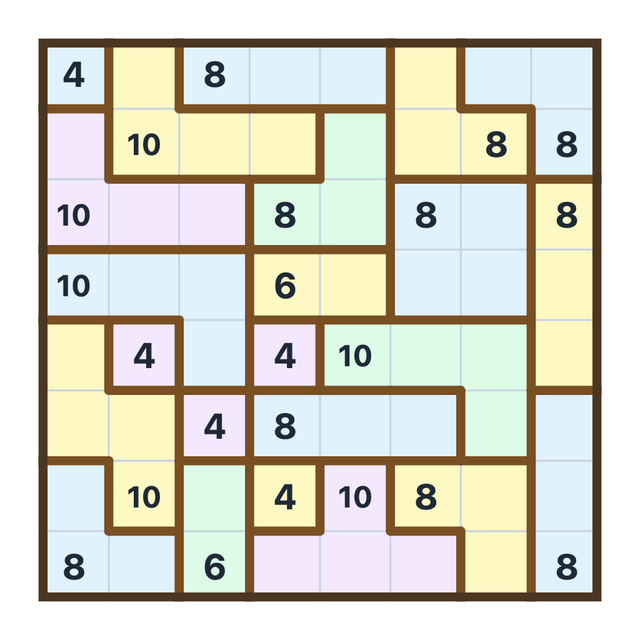
Fence the board into paddocks with the given perimeters.
About Fence It Up
Fence It Up divides a board into paddocks. You draw fences along the grid lines until every cell belongs to exactly one paddock, each paddock contains exactly one number, and that number is the total length of the fence around it, counted in cell edges. The outside edge of the board is always fenced and counts towards the paddocks along it.
The clue is a perimeter, which is what separates this from every other region-division puzzle. A perimeter does not fix the shape and it does not fix the area — a fence of 10 is satisfied by a 1×4 strip, a 2×3 block, or an L of five cells alike. Learning what a perimeter does and does not pin down is essentially the whole game.
Small clues are forced, and every clue is even
A polyomino's perimeter is always an even number, and the smallest possible paddock — a single cell — has a fence of 4. So the clues start at 4 and step in twos, and the two smallest are effectively free moves.
A 4 is a single cell: fence all four of its sides immediately, which also settles one border for each of its neighbours. A 6 is a domino, so the paddock is the clue plus exactly one orthogonal neighbour — at most four options, and the board edge or a nearby clue usually removes most of them. Do all the 4s and 6s before anything else.
A perimeter bounds the area from both sides
This is the deduction that makes larger clues tractable. An n-cell paddock has a perimeter of at most 2n + 2, which means a clue of P needs at least P/2 − 1 cells. And a perimeter is at least twice the width plus height of the shape's bounding box, so that box's sides can sum to no more than P/2.
Together those two facts give you a genuine size window. A clue of 10 needs at least four cells, and its bounding box sides sum to at most five — so a 2×3 block fits and a 3×3 one is impossible. Use the window rather than trying to enumerate shapes; it is what makes the bigger clues something you can reason about instead of guess at.
Fences never dead-end, and open marks are real
Look at any interior point where four cells meet. The number of fences meeting there is always 0, 2, 3, or 4 — never exactly 1, because a single fence would have to separate cells that are otherwise all in the same paddock. So three settled open borders at a point force the fourth open. Note that a fence of degree 1 is not an error while the other borders are still undecided; it is only an unfinished line.
Marking a border open is not bookkeeping either. It asserts that the two cells belong to the same paddock, which joins them permanently, and it can create a contradiction on its own — most obviously by joining two numbers, which no paddock may contain.
Choosing a size
The smallest board is introductory: clues are close together, most of them are small, and the board edge constrains nearly every paddock. The forcing patterns for 4 and 6 will carry much of it.
The larger boards have open middles where a clue of 10 or more has room for many shapes and no boundary to press against. There the size window and the tiling total become the primary tools — because the paddock areas must add up to the whole grid exactly, comparing the cells still unassigned against what the remaining clues can absorb is often what settles the last region.
What the difficulty labels mean here
The score measures how much search the solver needed after the forced moves. An Easy board has a chain of small clues and edge-constrained ones, each fixing the next.
Harder boards have several mid-sized clues in open space, where many shape combinations satisfy every local constraint and only the global area total or a distant clue eliminates them. Corner and edge clues remain the reliable way in, since a shape that would run off the board is never a candidate and those clues lose most of their options before you start.
Similar games
Games that share tags with Fence It Up.