☁️ Clouds
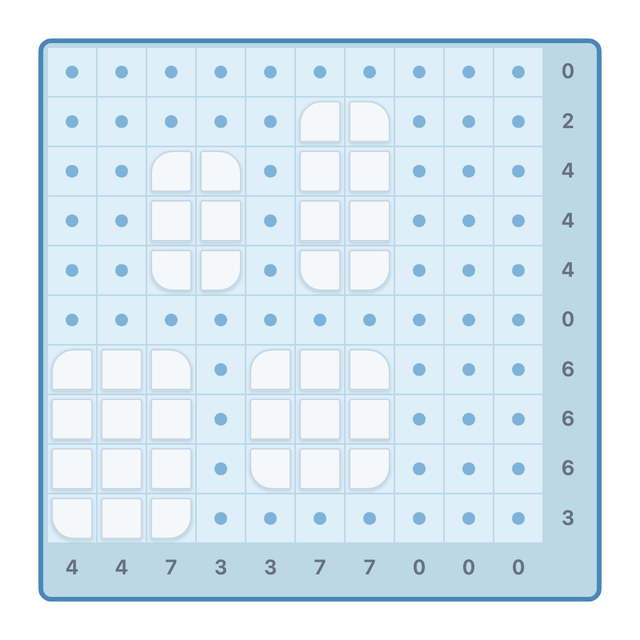
Shade rectangular clouds to match the row and column clues.
About Clouds
Clouds gives you a grid, a number beside every row and column counting how many of its cells are cloud, and one strong structural rule: every cloud is a solid rectangle, at least two cells wide and two cells tall, and no two clouds touch — not even at a corner. How many clouds there are, and what sizes they come in, is never told to you.
That withheld information is what makes the game. In most clue-counting puzzles the numbers are the whole problem. Here the numbers only get you started, and the real work is geometric: figuring out where a rectangle can and cannot fit, given that it must be at least 2×2 and must keep a clear ring of sky around itself.
The minimum size rule does most of the work
The rule that a cloud is never thinner than two cells in either direction sounds like a restriction on the answer. Treat it instead as a generator of moves. A single shaded cell is never a legal cloud, so every cloud cell you establish immediately implies at least three more around it, and usually the board has already ruled out most of the arrangements those three could take.
The corner of the board is the clearest case. A cloud cell in a corner has only one possible 2×2 block it can belong to, so it settles three more cells at once. Edges behave almost as well, and the same logic drives the mid-board deductions: if the cells above a pair of horizontal cloud cells are already clear sky, the cloud has no choice but to grow downwards.
Why clear sky is the productive mark
It is tempting to hunt for cloud cells, because they are the answer. In practice you will spend most of a solve marking clear sky, and the good players mark far more of it than feels necessary.
The reason is that clouds are rectangles, and a rectangle is defined by where it stops. Clear sky is the only thing that tells you where a cloud stops. A completed cloud pays this back immediately: as soon as its rectangle is whole, the entire one-cell border around it is clear sky, which typically resolves a row clue two lines away.
Choosing a size
The smaller boards are tight enough that a single cloud dominates a large fraction of the grid, so the 2×2 minimum bites hard and the clue arithmetic stays short. They are the right size for learning to see rectangles rather than shaded cells.
The larger boards change the problem qualitatively rather than just lengthening it. There is enough room for several clouds per line, which means a row clue of, say, six no longer suggests one cloud — it might be two clouds of three, or a 2×2 plus something wider, and the no-touching rule is what eventually decides between them. Expect to hold a couple of possibilities open and resolve them from the column clues instead.
What the difficulty labels mean here
Difficulty is measured by the solver, and in this game the score tracks something specific: how often the counting rules run dry and the rectangle geometry has to be tested by hand. An Easy Clouds board can be finished on line arithmetic almost alone — close a satisfied row, fill an exact fit, seal a finished cloud, repeat.
The harder boards contain positions where two different rectangle layouts both satisfy every visible clue, and only one survives when you follow it a few cells further. That is the search the score is counting, and it is why a Hard board here often feels like it hinges on a single ambiguous pair of columns.
How a solve usually opens
Sweep for zeros first and flood those lines with clear sky; they cost nothing and they shape the rectangles next door. Then look for lines whose clue equals the number of cells still available, and shade all of them.
After that, work the corners and edges, where the 2×2 minimum has the fewest ways to be satisfied. Once any cloud is complete, seal it — draw its ring of clear sky before doing anything else, because that ring is what turns the next clue into an exact fit.
Similar games
Games that share tags with Clouds.