🔢 Fillomino
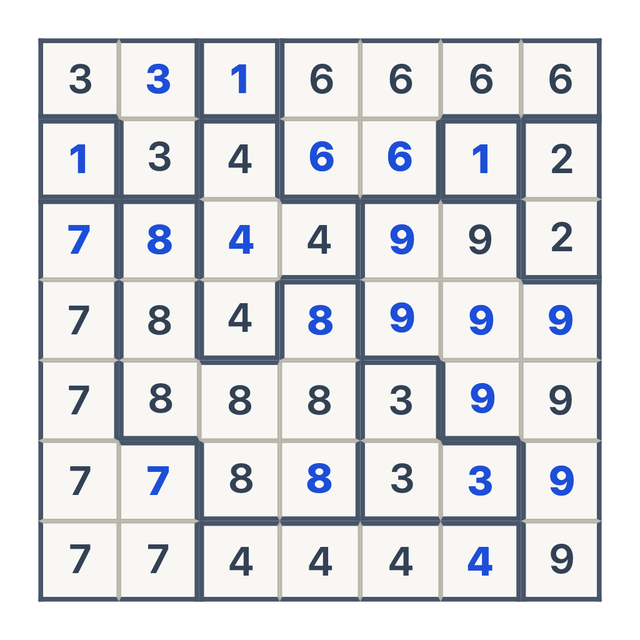
Make regions whose size matches the number inside.
About Fillomino
Fillomino has one of the shortest rule sets in the collection and one of the largest solution spaces. You write a positive number in every cell; cells holding the same number that touch orthogonally form a region; and a region marked N must contain exactly N cells. Two separate regions of the same size may not touch orthogonally, though they may meet at a corner.
What is unusual is that you are not told how many regions there are, what sizes they come in, or where their boundaries lie. Every other region-dividing puzzle here hands you a dot, a clue, or a wall to anchor on. Fillomino hands you a scattering of numbers and lets the size rule do all the anchoring, which is why it feels more like drawing than like deducing until it suddenly clicks.
A 1 is complete the moment you see it
The number 1 is a whole region by itself, so it is finished before you touch it — and by the same-size rule, none of its four orthogonal neighbours may be a 1 either. Every 1 on the board therefore hands you four immediate exclusions.
The same reasoning generalises and it is the engine of the game. Any region you complete is sealed: every cell orthogonally adjacent to it must hold a different number from the one you just closed. Completing small regions early is the fastest way to build boundaries you can reason against.
Two identical numbers that touch are one region
This is the deduction people miss at first, and it cuts both ways. If two cells holding the same number are orthogonal neighbours, they are necessarily part of the same region — so a pair of adjacent 2s is a finished region of exactly two cells, and everything around it must differ.
Run the argument backwards for the more powerful version. If two same-numbered cells are near each other but the region size is too small to contain both, they must belong to different regions — which means they may not touch, and every path that would connect them is forbidden. Two 3s a short distance apart often determine the shape of the cells between them entirely.
Count the space a region still needs
A clue of N needs N cells including itself, and it must find them in the cells it can actually reach. When a number sits in a corner or against a boundary of completed regions, the available space is often barely enough — and if only one shape fits, the region is determined without any guesswork.
The opposite case matters too. An unnumbered gap enclosed by finished regions must itself be a region, and its size is simply the number of cells in it. Small leftover pockets are frequently the easiest cells on the board, so look for them whenever progress stalls.
Choosing a size
The smaller boards keep the regions small and the whole grid visible, so the pairing and sealing rules resolve them quickly. They are the right place to learn to see regions instead of digits.
Larger boards allow larger numbers, and a large number is a genuinely different problem: a region of seven or eight cells has many shapes, and its boundary is decided far from its clue. On the bigger grids you will spend more time on the same-size separation rule, because with more regions there are far more opportunities for two equal-sized ones to collide.
What the difficulty labels mean here
The solver score measures how much search was needed past the forced moves. An Easy board is a sequence of small regions that seal each other in turn, each completion opening the next.
The harder boards contain large regions whose shape is ambiguous for a long stretch, where several tilings satisfy every visible constraint and only the same-size adjacency rule, applied a few cells out, eliminates the wrong ones. If you are stuck, look for two equal numbers that would end up touching.
Similar games
Games that share tags with Fillomino.