🌌 Galaxies
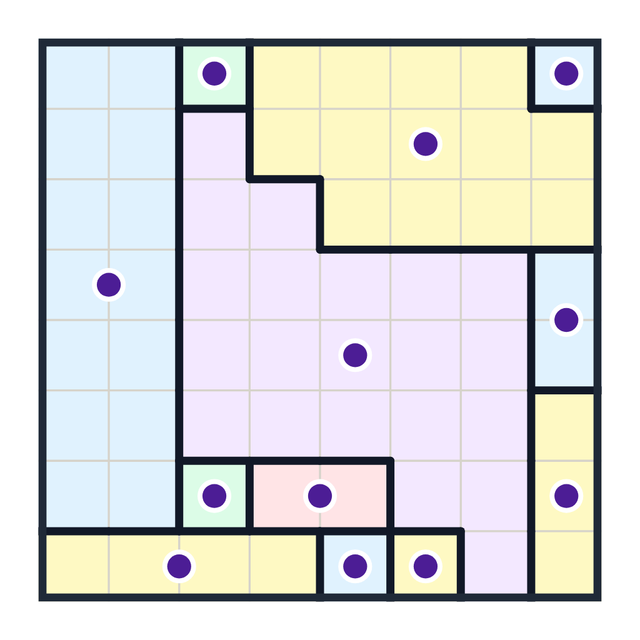
Draw rotationally symmetric galaxies around the dots.
About Galaxies
Galaxies is a symmetry puzzle. You divide the whole board into regions, each containing exactly one dot, and each region must be unchanged by a 180° rotation about its own dot — if a cell belongs to a galaxy, so does the cell directly opposite it through that dot. Every region must also be connected.
That rotational rule is unlike anything else here, and it changes how you work. In most region puzzles you extend a shape and check the rules afterwards. In Galaxies every cell you assign assigns a second cell for free, on the far side of the dot. The board fills in mirrored pairs, and a large part of the skill is learning to see the partner cell without counting squares.
Every cell comes with a partner
The symmetry rule is best used as a doubling machine rather than a constraint. Assign a cell to a galaxy and its opposite cell through that dot joins the same galaxy immediately. Deny a cell to a galaxy and its opposite is denied too.
The reverse is just as productive: if the cell opposite a candidate lies off the board, or already belongs to another galaxy, then the candidate cannot belong to this galaxy at all. That test costs one glance and eliminates a great many possibilities near the edges, which is why the border of a Galaxies board is usually the easiest part.
Where the dot sits changes everything
A dot is not always in the middle of a cell. It can sit on a border between two cells, in which case both belong to its galaxy, or on a corner where four cells meet, in which case all four do. Read these before you start — they are free cells, and they establish each galaxy's centre of rotation precisely.
The position of the dot also fixes the parity of its galaxy. A dot in a cell centre gives a galaxy an odd number of cells, because the centre cell is its own partner; a dot on a border or corner gives an even one. That is a real constraint when the leftover space on the board is running out.
Contested cells and orphans
Because every cell belongs to exactly one galaxy, the useful question for an ambiguous cell is which dots could claim it — a dot can only claim a cell if the opposite cell through that dot is also available. Often only one dot passes that test, and the cell is settled without considering shape at all.
The endgame argument is the opposite: look for cells no galaxy can reach. If a cell's only possible owners have all been ruled out, something earlier is wrong. And since every galaxy must be connected, a cell cut off from its dot by committed borders cannot belong to it, however well the symmetry works out.
Choosing a size
On the smaller boards the galaxies are compact, the dots are close together, and the partner cell is almost always visible in the same glance. The symmetry rule alone will usually finish them.
The larger boards give room for long, sprawling galaxies whose opposite ends are far apart, and that is where the game gets harder in a specific way: the partner of the cell you are considering may be most of the way across the board, so you must be deliberate about locating it. Connectivity also starts to matter, since a big galaxy can wrap around and strand cells behind it.
What the difficulty labels mean here
The measured score records how much search remained after the forced pairings. An Easy board has enough dots close to the edges and to each other that the symmetry test settles cells continuously.
The harder boards leave a large middle where several dots could plausibly claim the same cells and every assignment is symmetric-legal for a while. Those resolve through the leftover-space and connectivity arguments rather than through symmetry, which is why a Hard board here often comes down to counting cells rather than mirroring them.
Similar games
Games that share tags with Galaxies.