⚫ Masyu
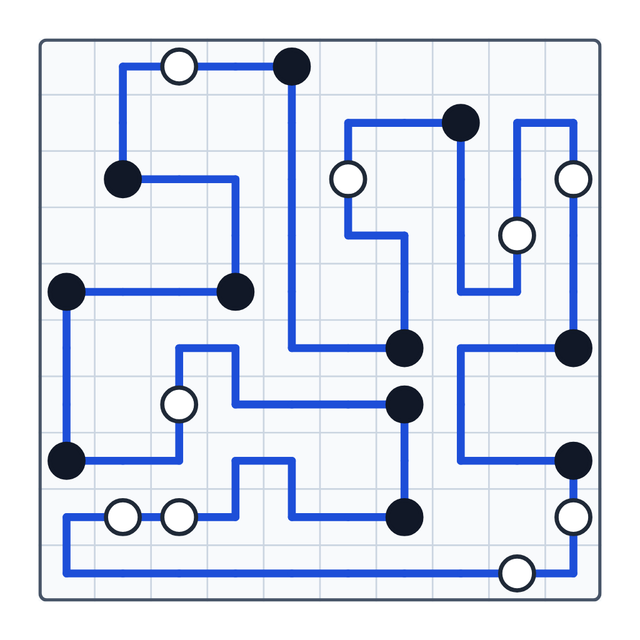
Draw one loop through every black and white pearl.
About Masyu
Masyu is a loop puzzle. You draw one closed circuit through the centres of cells, moving horizontally and vertically, and it must pass through every pearl on the board. The loop never crosses itself, never branches, and never enters a cell twice — so every cell it uses has exactly two segments, either running straight through or turning a right angle.
The pearls are the constraint, and there are only two kinds. A white pearl must be passed straight through, with a turn in at least one of the two cells immediately before or after it. A black pearl must be turned on, with the loop running straight for the next cell on both sides. Two rules, and everything else is a consequence of them.
A black pearl is three cells long
The black rule is the more forcing of the two, because it commits five cells at once in effect: the pearl itself turns, and the loop continues straight for one further cell in each of the two directions it leaves by. Think of a black pearl as an L whose arms are two cells long, not as a single turning cell.
That length is what makes black pearls near an edge so productive. A black pearl in the second row cannot send an arm upwards, since there is not room for two cells, so its orientation is immediately narrowed — and a black pearl in a corner region is often fully determined on sight.
A white pearl needs a turn beside it
The white rule has two halves and the second is easy to forget. Passing straight through is only half of it; the loop must also turn in at least one of the two cells adjacent along its direction of travel. A white pearl in a long straight run with no turn on either side is illegal, even though it is being passed straight through.
The useful consequence concerns white pearls in a line. Two adjacent white pearls must be traversed in the same direction, since each needs the other passed straight through — and a run of three or more in a line quickly becomes impossible to satisfy in one orientation, which decides the whole group.
Then the loop conditions take over
Once the pearls have given you their forced segments, the loop rules do the rest. Every cell the loop uses has exactly two segments, so a cell with two segments already drawn is closed and every other border of it is blocked. A cell with three impossible directions must use the fourth if it is used at all.
The strongest late-game tool is the closure rule: the finished figure is a single loop, so a short circuit that closes early and leaves pearls outside it is wrong. Whenever joining two ends would seal a small loop prematurely, that join is forbidden — and knowing it is forbidden usually forces the segment next to it.
Choosing a size
Small boards have pearls close to the edges and to each other, so their forced arms collide quickly and the loop assembles itself almost as soon as the pearls are resolved.
Bigger boards leave large empty areas the loop must cross without any pearl to guide it, and cells without a pearl may be used or skipped entirely. That is the real difficulty of a large Masyu: not the pearls, but deciding the route through the blank space, where the only constraints are the two-segment rule and the requirement that everything ends up in one circuit.
What the difficulty labels mean here
The score reflects how much search remained once the pearl rules and local loop logic were exhausted. On an Easy board the pearls are placed so that their forced arms chain together and the loop closes naturally.
The harder boards have sparse pearls and wide gaps, so several routes are locally legal and only the single-closed-loop condition eliminates them. If a Masyu board is stuck, look for a partial path that would close on itself too early rather than re-checking the pearls.
Similar games
Games that share tags with Masyu.