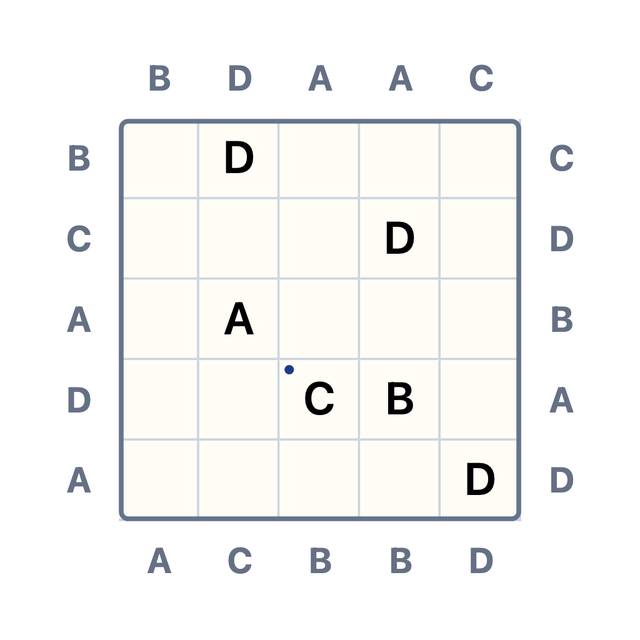
Fill each line so its edge clues reveal the first letters.
About ABC
ABC is a Latin-square puzzle with deliberate gaps. Each row and each column holds every letter for that board exactly once, plus one or two blank cells, and the letters around the outside name the first non-blank letter you meet looking along that line from that edge.
The blanks are what make it. In an ordinary Latin square an edge clue would name the cell right next to it, and the puzzle would be trivial. Here a clue says only that the named letter comes before every other letter in that direction — the blanks may sit in front of it, so the clue points at a letter somewhere along the line rather than at a particular cell.
What an edge clue actually tells you
Read a clue as an ordering statement, not a position. A clue of A on the left of a row means that among the non-blank cells of that row, A is leftmost — so every other letter in that row lies to the right of the A, and the only things that may precede it are blanks.
That immediately gives you the strongest form of the deduction: the letters named by the clue can only appear within the first few cells, because at most one or two blanks can be in front of it. Equally, no other letter may appear before the clued one, so the near cells lose every candidate except the clued letter and blank.
Clues on opposite ends and clues that are missing
Two clues on the same line apply independently and constrain it from both directions at once, which is far more powerful than either alone. If a row is clued A from the left and B from the right, the A precedes every other letter and the B follows every other letter, so on a short board the middle is nearly determined.
An absent clue is not a lack of information either. It imposes no first-letter requirement, which in practice makes that line the flexible one — the place where the blanks are likely to be doing their hiding. When a board feels over-determined, the unclued lines are usually where the resolution lives.
The blanks are worth tracking
You are not required to mark the blanks — once a line has all its letters placed, its blanks are decided by elimination. But tracking them is usually the faster route, because a blank is as strong a piece of information as a letter.
The reason is that each line has a fixed, small number of blanks. Knowing where one is means the remaining cells of that line must all be letters, which turns a loose clue into an exact one: if a clued row's only blank is already accounted for elsewhere, the clued letter must sit in the very first cell.
Choosing a size
These boards stay small, and the smallest has just one blank, which makes it a clean introduction — a clue is either satisfied by the first cell or by the second, and there is nothing else to consider.
Larger boards add letters and can add a second blank, and the second blank is the real jump in difficulty. With two blanks a clued letter might be third along its line, which weakens every clue at once and means you must lean much harder on the crossing constraint — a letter placed in one row removes it from a column, and that elimination is often what pins a blank.
What the difficulty labels mean here
The measured score reflects how much of the grid fell to direct elimination before the solver had to try a placement. An Easy board has enough clue pairs on the same lines that letters can be committed one after another.
The harder boards give you clues that each rule out a great deal without determining anything, so you work in candidates — this letter is in one of these two cells — until two such pairs interact through a shared row or column. Pencil marks are close to essential at that point.
Similar games
Games that share tags with ABC.