💡 Lighten Up
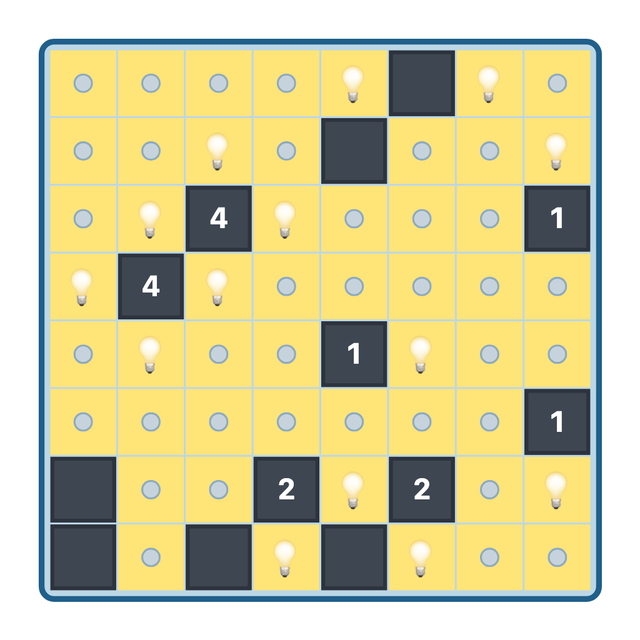
Place bulbs to light every cell without lighting another bulb.
About Lighten Up
Lighten Up is an illumination puzzle. Black walls divide a grid of white cells, and you place bulbs so that every white cell ends up lit. A bulb lights its own cell and shines horizontally and vertically until a wall or the board edge stops it. Two bulbs may never shine on one another, and a numbered wall must have exactly that many bulbs among the white cells directly beside it.
It reads as a covering problem — light everything — but it plays as a constraint problem, because of that second rule. Bulbs cannot see each other, so every bulb you place forbids an entire cross of cells. The puzzle is the tension between needing enough bulbs to cover the board and not being allowed to put them near each other.
Numbered walls are the only hard clues
Everything else on the board is geometry; the wall numbers are the arithmetic, and they are where a solve starts. A wall clued with the number of white cells beside it is fully determined — every one of those cells is a bulb. A wall clued 0 is equally strong in the other direction: none of its neighbours can be a bulb, and those cells will have to be lit from further away.
The intermediate numbers work by exclusion. A wall clued 1 whose neighbours include two cells that share a row or column can only use one of them anyway, since two bulbs in a line would shine on each other. Combinations like that resolve many clues without ever picking the cell directly.
Unlit cells are clues too
The rule that every white cell must be lit is not just the victory condition — it is a source of deductions all the way through. Take any white cell and ask which cells could possibly light it: itself, and the cells reachable along its row and column before a wall intervenes. That is a small set, and it must contain at least one bulb.
When walls have narrowed that set to a single cell, you have a forced bulb even with no numbered wall involved. This is the deduction that finishes most boards, and it is why marking cells that cannot hold a bulb pays off: those marks are exactly what shrink these candidate sets.
Choosing a size
The small boards are dense with walls relative to their area, so sightlines are short and each bulb governs a small neighbourhood. They are almost purely clue-driven and are the natural place to learn how the no-mutual-illumination rule interacts with a wall clue.
The large boards open up long corridors, and long corridors are the interesting case: a single bulb can light a dozen cells, which makes it powerful and also makes it exclude a great deal. Expect long-range effects, where a bulb at one end of a row decides a cell far away, and expect to think more about which cells are still dark than about which walls are still unsatisfied.
What the difficulty labels mean here
The solver score reflects how much of the board fell to the two direct methods — satisfying wall clues and finding cells with only one possible light source — versus how much needed a tentative placement.
An Easy board is a chain of forced bulbs from start to finish. On the harder boards you will reach a position where several cells are still dark, every candidate source for them is ambiguous, and the way through is to assume one bulb and find the contradiction. Often the contradiction is not a lighting conflict but a wall clue that can no longer reach its number.
How a solve usually opens
Do all the saturated and zero walls first — the ones where the clue equals the available neighbours, and the ones clued 0. Both are free, and they seed the board with bulbs and with marks.
Then place the cross of light from each bulb, and go looking for dark cells in corners and short dead-end corridors. Those have the fewest possible sources, so they are where a forced bulb appears first. Every bulb you place shortens the candidate list for every dark cell in its row and column, so recheck them after each placement rather than in a separate pass.
Similar games
Games that share tags with Lighten Up.