🌳 Parks
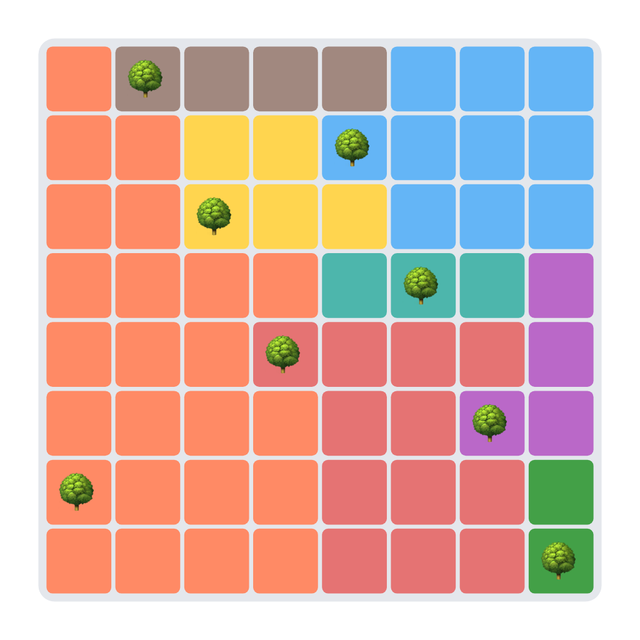
Place one tree in every row, column, and region.
About Parks
Parks is a pure deduction puzzle with almost no arithmetic in it. The board is divided into coloured regions, and your job is to plant exactly one tree in every row, every column, and every region, without any two trees ever touching — not side by side, and not at a corner. Nothing is hidden from you at the start: every clue you will ever get is already on the board in the shape of those regions.
That makes it an unusually honest puzzle. There is no guessing phase and no moment where you have to hold six possibilities in your head at once. Every step follows from something visible, and the whole solve is a chain of small certainties — which is why Parks tends to be the game people finish first and then keep coming back to at larger sizes.
The idea behind the rules
The three placement rules pull against each other in a way that is worth understanding rather than memorising. One tree per row and one per column means the trees form a permutation — a diagonal scattered across the grid, never two in a line. One tree per region means that permutation has to respect the colours as well. And the no-touching rule means no two of those trees can be diagonal neighbours, which quietly removes far more options than it first appears to.
The consequence you will use constantly: a region squeezed into a small area is the most informative thing on the board. A region occupying three cells in a single row has already told you that row's tree is one of those three, and that every other region touching them has lost candidates.
Choosing a size
Board size in Parks is not a difficulty setting so much as a change of texture. Small boards are tight: regions are cramped, constraints collide immediately, and a solve is often ten or twelve deductions from start to finish. They are the right place to learn the no-touching rule, because a mistake shows up within a move or two.
Larger boards open up. There is more empty space between regions, so the early moves are about finding the two or three places where constraints already overlap, then letting that pressure spread outward. A large board is not necessarily harder — it is longer, and it rewards marking the cells you have ruled out rather than trying to keep them in your head.
What the difficulty labels mean here
The labels on this site are measured, not assigned. Every puzzle is run through the same solver a person would reason with, and the score records how much search the solver needed beyond pure logic — how many times it ran out of forced moves and had to try a branch. Easy puzzles need none: there is always a next certain step. Insane puzzles have positions where every remaining move requires looking two or three steps ahead before one option collapses.
This matters when you pick. A Hard puzzle on a small board is not a longer Easy puzzle; it is one that contains a genuine bottleneck, usually a single cell that takes real work to resolve, with the rest falling quickly once it does.
How a solve usually opens
Most Parks boards give you a free move somewhere. Look first for a region confined to one row or one column: it may not tell you where its tree is, but it tells you that no other region can take that line, which often forces a neighbour immediately. Then look for the smallest region on the board and check whether the no-touching rule has already reduced it to one viable cell.
From there the loop is mechanical. Place a tree, mark the eight cells around it as impossible, then recount the three groups that tree just changed — its row, its column, and its region. A placement that finishes a group is the most valuable kind, because closing a group turns every remaining cell in it into a mark, and those marks are what force the next placement.
Where people go wrong
Two mistakes account for most stuck boards. The first is forgetting that the no-touching rule works diagonally — a tree placed at a region's corner blocks the cell diagonally across from it, and that cell is easy to overlook because it belongs to a different region and a different row.
The second is not marking. Parks is solvable without ever marking a ruled-out cell, but only on small boards. On anything larger, the deductions that matter are about counting how many candidates a line has left, and you cannot count candidates you have not written down.
Similar games
Games that share tags with Parks.