🔧 Pipes
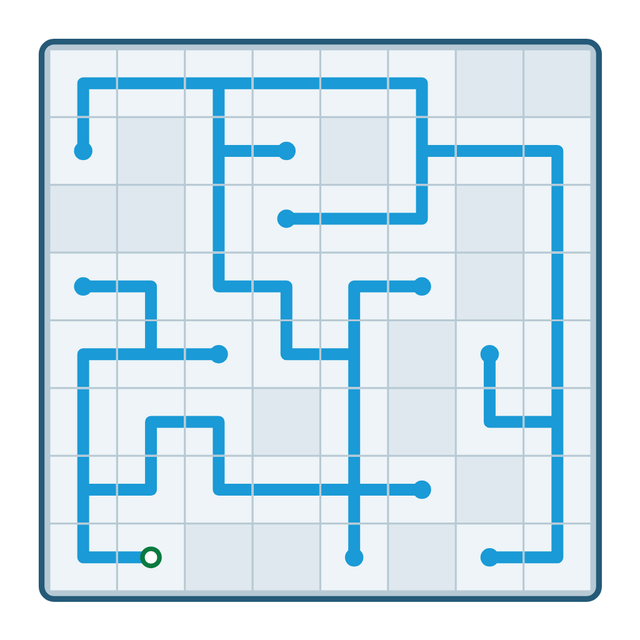
Turn the pipes to make one connected, leak-free network.
About Pipes
Pipes is unusual on this site: you never add or remove anything. Every tile is already on the board with its shape fixed, and your only move is to rotate a tile by quarter-turns. The goal is a board with no leaks — every opening meets a matching opening next door, none facing a wall or an empty cell — where all the pipework forms a single connected network containing no closed loop.
That makes it feel more tactile than the marking games, and it is often the one people solve fastest without reading any instructions. It is worth reading them anyway, because two of the win conditions are easy to miss: a board can be completely leak-free and still be wrong, either because it has fallen into two separate networks or because it contains a loop.
Edges and corners decide themselves
No opening may face off the board, and that single fact fixes a large part of the puzzle before you have thought about connectivity at all. A tile on the top row cannot point upwards, so a straight pipe there must lie horizontally, and an elbow has only two remaining orientations instead of four.
Corners are stronger still: two directions are forbidden at once. A corner tile with three openings is impossible, a corner elbow has exactly one legal rotation, and a corner straight cannot exist. Work the whole border first — it is nearly free, and it gives the interior something to attach to.
Matching is a two-way commitment
An opening cannot dangle. If a tile points right, its right-hand neighbour must point left; if it does not point right, the neighbour must not point left either. Every rotation you settle therefore constrains its neighbour in both directions, which is what lets deductions travel.
Empty cells and the board edge are the same thing for this purpose: a hard boundary that no opening may face. Treat an empty cell as a wall in the middle of the board and the tiles around it usually resolve at once.
The no-loop rule is the one people forget
Branches, tees and crosses are all allowed, so it is natural to assume anything connected is acceptable. It is not: the finished network must be a tree. If you can trace a path that leaves a tile and returns to it, the board is invalid however well it fits together.
This is genuinely useful rather than merely a rule to obey. When two partly-built arms of the network approach each other and joining them would close a circuit, you know they must not join — which usually forces the tile between them into its only other orientation.
Choosing a size
Small boards have a high proportion of border tiles, and the border is where rotations are most constrained, so they tend to fall out quickly and almost mechanically.
Large boards have big interiors where several rotations remain locally legal for a long while, and the deciding argument becomes global rather than local: connectivity and the loop rule. This is where the game stops being a fidget and starts being a puzzle — you will find yourself leaving a region ambiguous, building elsewhere, and returning once the network's shape has decided it.
What the difficulty labels mean here
The measured score reflects how much of the board could be rotated into place by local matching alone. Easy boards are pure propagation: the border fixes a ring, the ring fixes its neighbours, and the wave crosses the grid.
Harder boards leave interior regions where local matching admits more than one arrangement, and only the single-network or no-loop condition rules the extras out. If a Pipes board feels stuck despite no visible leaks, count your networks and look for a circuit before doubting your rotations.
Similar games
Games that share tags with Pipes.