🏰 Sentinels
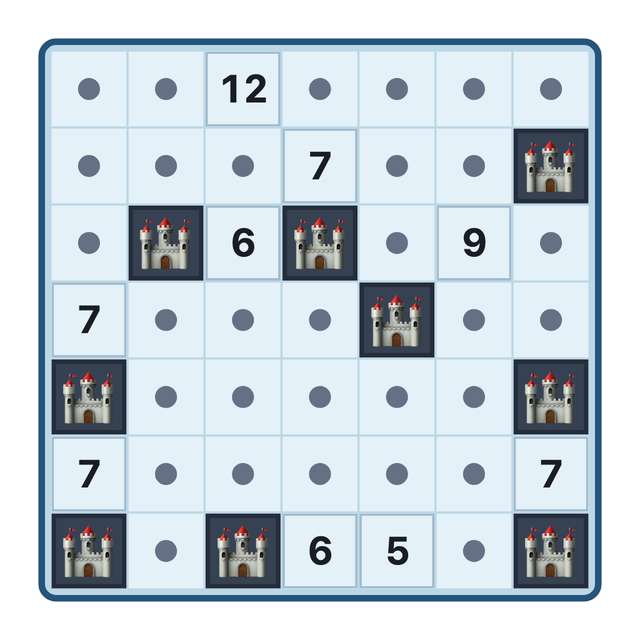
Place castles so each sentinel sees its required spaces.
About Sentinels
Sentinels asks you to place castles on a grid so that every numbered cell — the sentinel — sees exactly its own number of spaces. A sentinel counts its own cell plus every open cell it can see in the four orthogonal directions, stopping at the first castle in each direction. Castles may not share an edge, though they may touch at a corner, and all the open cells must remain a single connected area.
What makes it distinctive is that a castle does two opposite things at once. It blocks a sightline, reducing what nearby sentinels can see, and it takes a cell out of the open area, which the connectivity rule may not permit. Almost every deduction here is a trade between those two effects.
Sightlines are the arithmetic
A sentinel's number is a sum of four arms plus itself, and that decomposition is how you work with it. If a sentinel clued 8 already has three arms blocked close in, contributing four cells between them, the fourth arm must supply exactly three more — which pins the castle in that direction to a single cell.
The upper bound is just as useful. Count how far each arm could possibly reach with no castle in it at all, add one for the sentinel's own cell, and you have the largest number that sentinel could ever see. A clue near that maximum means almost nothing blocks it, and every candidate castle along its arms is immediately suspect.
The connectivity rule is not a formality
It is easy to read "the open cells stay one connected area" as a condition you check at the end. It is actually one of the sharpest deduction tools on the board, and it works in the opposite direction from the sightline counting.
The pattern to look for is a cell or group of cells whose only escape route runs through a candidate castle. If placing a castle there would seal them off, that castle is impossible — regardless of how well it satisfies the numbers. Late in a solve this argument decides more cells than the clues do, particularly around the board edges and in narrow channels between committed castles.
Choosing a size
The smallest boards are genuinely small — every sightline runs nearly the full width, so each castle affects almost every sentinel, and the puzzle is a tight algebraic knot you can hold in your head. Connectivity is rarely the binding constraint at this size.
As the boards grow, sightlines get long and the balance shifts. Sentinels far apart stop interacting, so the board becomes several loosely coupled neighbourhoods rather than one system, and the connectivity rule starts doing real work because there is now enough room to accidentally wall a region off. On the larger boards, check connectivity every time you place a castle rather than at the end.
What the difficulty labels mean here
The score counts how far the solver had to search past its forced moves. Because this game has two quite different rule families — counting and connectivity — the harder boards tend to be the ones that require you to switch between them mid-deduction.
An Easy board can be solved by sightline arithmetic almost throughout. On a Hard or Insane one there will be a point where every remaining castle satisfies the numbers and only a connectivity argument, followed two or three cells out, eliminates the wrong ones.
How a solve usually opens
Start with the extreme clues. A sentinel whose number equals its maximum possible view has no castle anywhere along its arms — mark all of those cells as open space, which is a large free gain. A sentinel with a very low number needs castles pressed close in on nearly every side.
Then use the no-shared-edge rule to propagate: every castle makes its four orthogonal neighbours open space. Recount every sentinel whose arms pass through a cell you just changed, and watch for arms that have become exactly determined.
Similar games
Games that share tags with Sentinels.