⛺ Tents
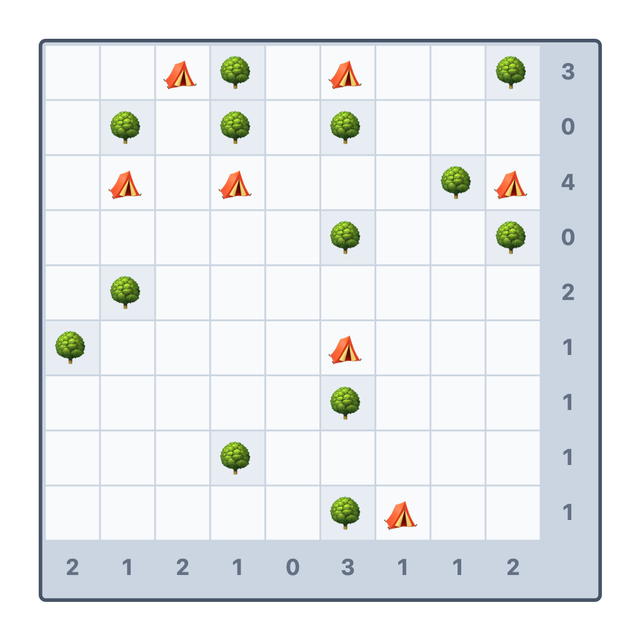
Pair each tree with a tent; tents cannot touch.
About Tents
Tents pairs every tree on the board with a tent beside it. A tent sits directly above, below, left or right of its tree — never diagonally — no two tents may touch even at a corner, and the numbers beside the rows and columns count the tents in each line exactly.
The pairing is what distinguishes it. It is not enough for each tent to have some tree next to it: the finished board needs a one-to-one matching, each tree with its own tent. A tent may stand next to several trees and a tree may have several candidate tents, provided a complete pairing exists — which means a placement can be locally perfect and globally impossible.
The count is fixed before you start
Because every tree gets exactly one tent, the number of tents equals the number of trees, and the row clues and the column clues must each add up to that same number. That is worth checking on sight: it tells you the total you are working towards and often reveals that a line's clue is larger than you assumed.
From there the clues behave like any exact line count. A zero empties a line completely, a clue matching the available cells fills it, and a satisfied line turns every remaining cell to grass. Those grass marks are what constrain the trees nearby.
Work from trees with few options
Each tree needs a tent in one of at most four cells, and the board usually removes some of them at once — the edge of the grid, another tree, or a cell already marked grass. A tree with a single remaining candidate is a forced tent, and these are the moves that seed a solve.
The no-touching rule then propagates hard. A placed tent forbids tents in all eight surrounding cells, which frequently reduces a neighbouring tree to one option, and that is the chain reaction the game runs on. Trees clustered together are the most productive place to look, because their candidate cells overlap and the exclusions compound.
The pairing rule catches what counting misses
The subtle deductions in this game are about matching rather than adjacency. If two trees can only be served by the same single cell, the position is already broken — two trees cannot share one tent. Conversely, if two trees between them have only two candidate cells, those two cells are both tents, and every other tent candidate touching them is eliminated.
This is the same reasoning as the classic pair argument in other logic puzzles, applied to trees and their candidate cells. It resolves positions where every line count is satisfiable and no single tree is forced, which is exactly where the harder boards get their difficulty.
Choosing a size
Smaller boards have fewer trees, more space per tree, and short lines, so the line counts are decisive and the pairing rule rarely needs to be invoked explicitly.
Larger boards pack in more trees, and the character changes: candidate cells start to overlap heavily, the no-touching rule becomes the dominant constraint, and the matching argument becomes something you use routinely rather than as a last resort. Marking grass thoroughly matters more here, since the counting deductions depend on knowing how many cells a line has genuinely left.
What the difficulty labels mean here
The score records how much search the solver needed once the forced tents ran out. An Easy board offers a continuous supply of trees with exactly one candidate.
Hard and Insane boards reach positions where every tree has two or more options and every line count is still satisfiable several ways. Those are resolved by the pairing arguments above, or by assuming a tent and finding that some tree elsewhere is left with nowhere to go. Note that marking every non-tent cell as grass is optional for completion — but on these boards it is how you find the deduction.
Similar games
Games that share tags with Tents.